
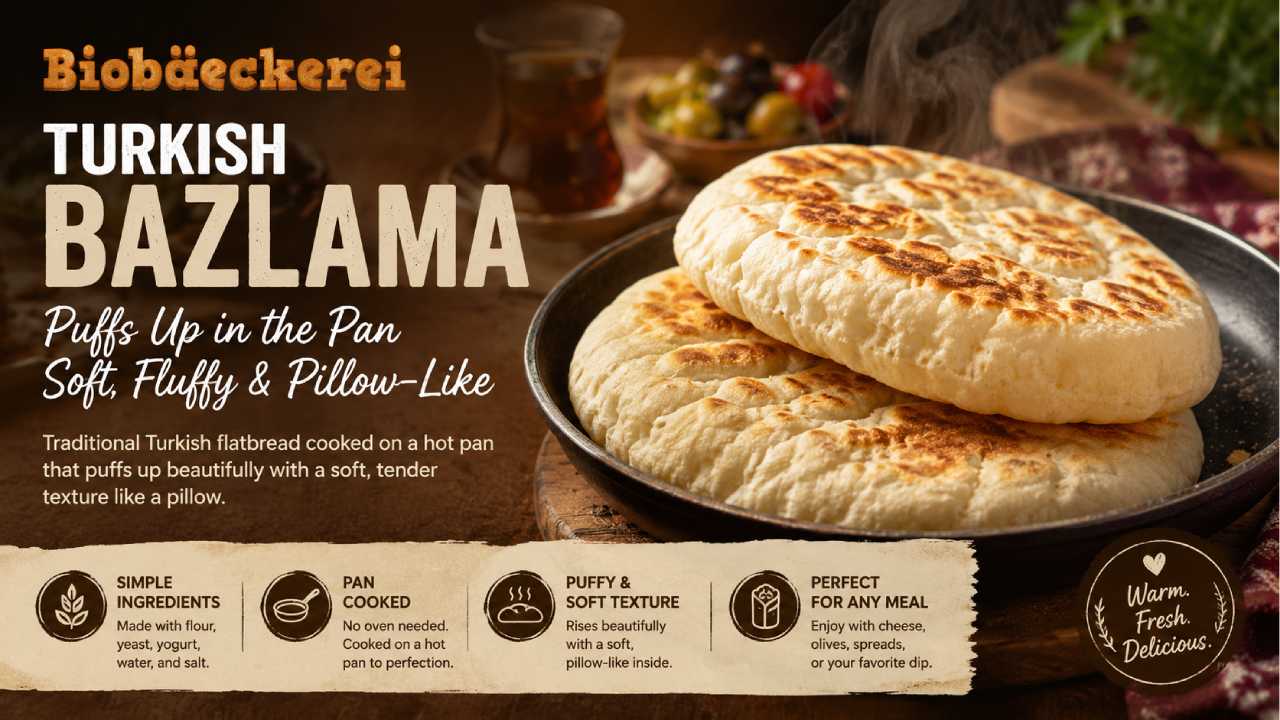
Turkish Bazlama Puffs Up in the Pan With a Soft, Pillow-Like Texture
Biobaeckerei – Turkish Bazlama bread proves that memorable bread does not always require an oven or complicated equipment. Bazlama is a traditional Turkish flatbread commonly prepared from a yeast-leavened dough and cooked on a hot surface. Its appearance is rustic, with scattered brown spots and a thick, tender interior. Unlike paper-thin flatbreads, bazlama has enough depth to develop a pleasantly soft crumb. As the dough meets the hot pan, trapped gases and steam expand inside. Consequently, sections of the bread begin to rise and form its characteristic pillowy shape. The exact amount of puffing can vary because dough hydration, fermentation, thickness, and cooking temperature all matter. Nevertheless, properly prepared bazlama should remain flexible rather than dry or brittle. Its straightforward method is part of its charm. Flour, yeast, water, salt, and sometimes yogurt or milk can become warm bread within a relatively short time. That simplicity makes bazlama both approachable for home bakers and deeply connected to everyday Turkish cooking.
Read Also: Homemade Butterscotch Pudding with a Rich Caramel-Like Flavor
Why Bazlama Can Become So Soft and Puffy
The dramatic rise of bazlama in a pan is not magic. Instead, several basic bread-making processes happen at the same time. During fermentation, yeast consumes available sugars and produces carbon dioxide. The dough’s gluten network helps hold those gas bubbles. Then, once the shaped dough touches a sufficiently hot surface, moisture inside begins turning into steam. Existing gas also expands as the temperature rises. Together, these forces create pockets throughout the bread and can lift large sections of its surface. However, bazlama does not always inflate into one completely hollow pocket like some pita breads. Its interior can contain a mixture of small and larger air pockets. Therefore, describing it as soft and pillowy is generally more accurate than promising a perfect balloon every time. Gentle handling also matters. Pressing too aggressively after fermentation can remove much of the trapped gas. Meanwhile, dough rolled extremely thin may produce a different texture. A moderately thick round gives Turkish Bazlama bread enough structure to develop its distinctive tender interior.
Yogurt Can Add Tenderness and a Pleasant Tang
Bazlama recipes vary between households and regions, so there is no single formula that defines every loaf. Some versions rely mainly on flour, water, yeast, and salt. Others incorporate milk or yogurt. When yogurt is included, it contributes moisture and acidity while adding a subtle tang to the finished bread. It can also support a tender eating texture. However, yogurt should not be presented as mandatory for authentic bazlama because traditional preparations are diverse. For a home-style version, plain unsweetened yogurt works particularly well. Full-fat yogurt can create a richer dough, although lower-fat varieties can also work. The final hydration may need adjustment because yogurt differs considerably in thickness. Greek-style yogurt, for example, usually contains less free moisture than a thinner natural yogurt. Therefore, bakers should pay attention to the dough rather than following liquid measurements blindly. Ideally, it should feel soft and slightly tacky without becoming impossible to handle. That supple consistency helps create the tender crumb associated with fresh Turkish Bazlama bread.
Fermentation Builds Flavor Before the Pan Gets Hot
Waiting for dough to rise may appear like an inactive stage, yet important changes are taking place. Yeast produces carbon dioxide, while enzymes help transform components within the flour. As a result, fermentation affects both volume and flavor. For bazlama, the dough generally needs enough time to become visibly expanded and airy. Room temperature influences how quickly this happens. A warm kitchen accelerates fermentation, while a cooler room slows it down. Therefore, judging the dough by appearance is more reliable than following the clock alone. After the first rise, the dough can be divided into portions and shaped into rounds. A short resting period before final shaping also makes the gluten easier to stretch. However, overproofing can weaken structure and make handling difficult. Underproofed dough, meanwhile, may remain dense. The ideal point lies between those extremes. This stage demonstrates why seemingly simple bread still rewards patience. Bazlama contains relatively few ingredients, yet fermentation transforms them into something far more aromatic, elastic, and satisfying than their basic components might suggest.
A Hot Pan Creates Bazlama’s Signature Golden Surface
One of bazlama’s biggest advantages is that it can be cooked without a conventional oven. Traditionally, flatbreads can be prepared on heated cooking surfaces, while modern home cooks often use a skillet, griddle, or heavy pan. The pan should be thoroughly preheated before the dough goes in. However, extreme heat can burn the outside before the center cooks. Medium-high heat is therefore a useful starting point, although every stove and pan behaves differently. Once the dough touches the surface, bubbles should gradually appear. Brown spots then develop where the bread makes closer contact with the pan. Turning it allows the second side to cook while the interior continues expanding. If the bread darkens almost immediately, reducing the heat can prevent scorching. Conversely, a pale and dry result may indicate that the pan is not hot enough or cooking takes too long. A heavy skillet can help maintain stable heat. Ultimately, successful Turkish Bazlama bread depends more on temperature control than expensive equipment.
A Practical Bazlama Recipe for Home Kitchens
A straightforward home batch can begin with about 500 grams of all-purpose or bread flour, 7 grams of instant yeast, and 8–10 grams of salt. Add roughly 200 milliliters of lukewarm water and 150 grams of plain yogurt. Because flour absorption varies, keep extra water nearby and add it gradually if the dough feels firm. Mix the ingredients until no dry flour remains. Then, knead until the dough becomes smoother and elastic. Cover it and leave it in a warm place until noticeably expanded, which may take around one hour depending on temperature. Next, divide the dough into six equal portions and shape them into balls. Let them rest briefly before flattening each one into a thick round. Meanwhile, preheat a heavy skillet without excessive oil. Cook each round until bubbles develop and the underside gains golden-brown patches. Turn it and cook the other side until fully set. Finally, transfer the finished bazlama beneath a clean kitchen towel. Trapping some residual moisture helps keep the breads soft while the remaining pieces cook.
Small Cooking Details Make a Noticeable Difference
Several small adjustments can improve bazlama dramatically. First, avoid adding excessive flour while kneading. A very stiff dough can produce bread that feels heavier and less tender. Instead, lightly flour the work surface only when necessary. Second, allow the shaped portions to relax before flattening them. Resting reduces resistance in the gluten network and makes shaping easier. Third, keep the rounds reasonably consistent in thickness. Uneven dough can leave one section undercooked while another becomes too dark. During cooking, watch the bread rather than relying entirely on a timer. Bubbles, puffing, and golden patches provide useful visual signals. Furthermore, keep cooked pieces covered with a clean towel. Fresh bazlama loses moisture quickly when left exposed to air. Some cooks brush the warm surface with butter or olive oil for additional richness, although this step is optional. These techniques are simple, yet together they make Turkish Bazlama bread softer and more consistent. Good flatbread often depends on observation and touch as much as exact measurements.
Bazlama Works With Both Savory and Sweet Pairings
Fresh bazlama is versatile because its flavor is mild enough to accompany many foods. Served warm, it can be torn into pieces and paired with cheese, olives, tomatoes, eggs, or spreads. It also works well alongside soups, stews, grilled vegetables, and meat dishes because its soft crumb can absorb sauces. For a simple breakfast, warm bazlama with butter can be satisfying on its own. Honey or preserves can move it toward the sweeter side without turning the bread into dessert. Meanwhile, splitting thicker pieces creates space for sandwich fillings. This versatility explains why flatbreads can remain practical even as food habits evolve. Rather than demanding one specific presentation, bazlama adapts easily to what is already on the table. Still, serving it warm makes a significant difference. Heat restores softness and releases more aroma from the bread. If leftovers have cooled, reheating them briefly in a dry pan can revive much of their original texture without making the surface excessively crisp.
Proper Storage Helps Preserve Its Pillow-Like Texture
Bazlama tastes best shortly after cooking, but leftovers can still remain enjoyable with sensible storage. First, let the bread cool enough to prevent heavy condensation. Then, place it in an airtight container or tightly sealed bag. At room temperature, it is best consumed relatively quickly because homemade bread lacks the preservatives found in many commercial products. For longer storage, freezing is usually more effective than refrigeration. Refrigerators can accelerate the firming associated with bread staling. To freeze bazlama, separate individual pieces with parchment if necessary and seal them well. They can then be thawed and warmed in a skillet before serving. A few drops of water added to the pan or lightly applied to the bread can help generate steam during reheating. However, too much moisture may make the surface soggy. These simple steps preserve one of bazlama’s most appealing characteristics: the contrast between lightly browned surfaces and a soft interior that remains pleasant to tear, fold, and share.
Turkish Bazlama Shows Why Simple Bread Can Feel Special
What makes Turkish Bazlama bread memorable is not an elaborate ingredient list. Instead, its appeal comes from transformation. A soft ball of fermented dough enters a hot pan and slowly develops bubbles, golden patches, and an airy crumb. Watching that change happen makes the cooking process part of the experience. More importantly, bazlama illustrates how traditional bread techniques can remain useful in contemporary kitchens. No specialized bread oven is required, and the ingredients are widely accessible. At the same time, achieving an excellent result still requires attention to fermentation, hydration, shaping, and heat. That balance between simplicity and technique gives bazlama its enduring character. It can accompany a full meal or become a quick snack while still feeling substantial. Most importantly, its pillow-like softness is not simply a visual trend. It reflects the interaction of yeast, gluten, moisture, and heat. When those elements work together, a humble pan-cooked flatbread becomes one of the most comforting forms of freshly baked bread.
