
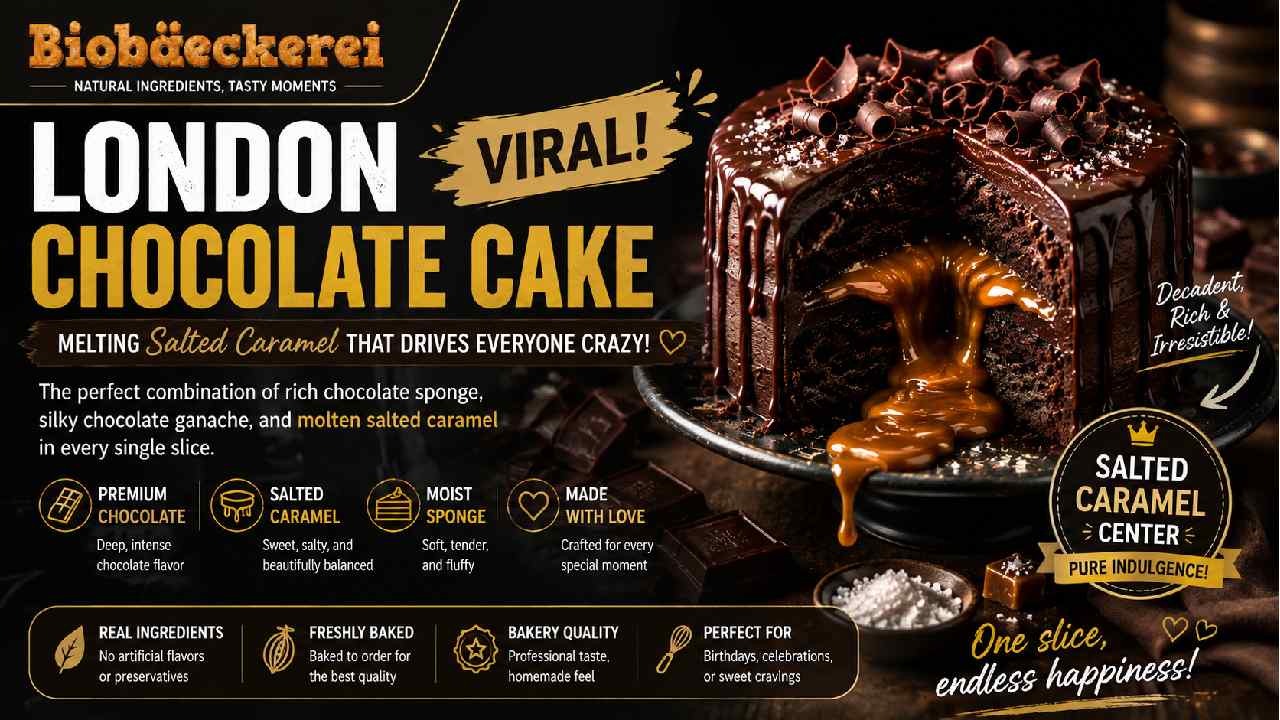
London Chocolate Cake Goes Viral, Salted Caramel Center Sparks Curiosity
Biobaeckerei – London Chocolate Cake is becoming an eye-catching dessert concept for chocolate lovers who enjoy dramatic layers and a flowing salted caramel center. Rather than referring to one protected or historically standardized British recipe, the name is better understood as a modern bakery-style creation. Its appeal comes from combining a moist chocolate sponge, silky chocolate ganache, and salted caramel. Once sliced, the caramel hidden between the layers can slowly run onto the plate. That visual makes the cake particularly suited to short-form food videos and social media. However, the flavor matters just as much as the presentation. Dark cocoa brings bitterness, caramel contributes sweetness, and salt creates contrast. Meanwhile, cream and butter give the filling a smooth texture. The result can feel luxurious without requiring unusual ingredients. For home bakers, the key is controlling temperature and consistency. Caramel that is too warm will escape immediately, while an overly cold filling may lose the soft texture that makes this cake so tempting.
Read Also: Date and Oat Energy Balls, a Naturally Sweet Healthy Snack
What Exactly Is London Chocolate Cake?
Despite its fashionable name, London Chocolate Cake should not be presented as a single traditional cake with a universally accepted recipe. British baking has a rich chocolate-cake tradition, yet modern bakeries frequently create their own names for layered desserts. Therefore, recipes carrying this title can vary considerably. One version may feature dark chocolate sponge and caramel. Another may use chocolate ganache, mousse, or fudge frosting. For this article, the cake is treated as a contemporary layered chocolate dessert with salted caramel at its center. That distinction matters for accuracy. It avoids creating a fictional history around a modern food trend. More importantly, it gives home bakers room to adapt the recipe. The defining experience is the contrast between deep chocolate and buttery caramel with a noticeable touch of salt. Visually, a tall cake with glossy ganache also creates the premium bakery appearance associated with modern celebration cakes. In other words, the name may attract attention, but texture and flavor ultimately determine whether people want another slice.
Salted Caramel Creates the Cake’s Signature Moment
The most memorable feature of London Chocolate Cake is its salted caramel filling. Caramel begins with heated sugar. As its temperature rises, sugar develops increasingly complex aromas and deeper color. Cream and butter are then commonly added to create a sauce. Finally, salt provides contrast to the sweetness. The difficult part is achieving the correct consistency. A very thin caramel can soak into the sponge or leak from the sides. Meanwhile, caramel that becomes too firm may feel chewy once the cake is chilled. For a layered cake, the sauce should usually cool before assembly. It should remain spreadable but thick enough to stay inside a frosting barrier. A ring of ganache or buttercream around each cake layer can help contain it. Then, when the finished cake reaches a comfortable serving temperature, the center becomes softer again. This technique produces the controlled caramel flow that looks impressive without turning the entire cake into a sticky puddle.
Dark Chocolate Keeps the Sweetness Under Control
Salted caramel can become intensely sweet. Therefore, chocolate selection has an important role in balancing London Chocolate Cake. Unsweetened cocoa powder works well in the sponge because it adds chocolate flavor without introducing large amounts of extra sugar. For ganache, semisweet or dark chocolate can provide additional bitterness. Chocolate containing roughly 60 to 70 percent cocoa is a practical starting range for many recipes, although personal preference matters. The goal is not to make the cake bitter. Instead, the chocolate should prevent caramel and frosting from overwhelming every bite. Coffee can also deepen the perceived chocolate flavor in some cake formulas. However, it is optional and should not dominate the dessert. Salt plays a similar balancing role. A small amount can sharpen flavor, but excessive salt quickly becomes distracting. In my view, this balance is what separates a visually impressive cake from one people genuinely enjoy eating. Every component should contribute something different rather than simply adding more sweetness.
A Moist Chocolate Sponge Builds the Foundation
A dramatic filling needs a cake strong enough to support it. At the same time, the sponge should remain tender. A practical London Chocolate Cake base can use all-purpose flour, cocoa powder, sugar, eggs, oil, buttermilk, and chemical leavening. Oil is particularly useful because it stays liquid at room temperature. As a result, an oil-based chocolate cake can retain a soft texture after cooling. Buttermilk contributes acidity and moisture. If a recipe combines acidic ingredients with baking soda, the proportions should be designed carefully. Hot coffee or hot water is also common in chocolate cake batter. It helps disperse cocoa and creates a relatively fluid mixture. However, bakers should follow a tested formula instead of changing liquid ratios randomly. Too much liquid can weaken the structure. Overbaking creates the opposite problem and leaves the sponge dry. For layered cakes, even baking is especially important. Flat, stable layers are much easier to fill with caramel than fragile cakes with large domes or cracked centers.
A Practical Recipe for the Chocolate Cake Layers
For one 20-centimeter or 8-inch layered London Chocolate Cake, a workable formula starts with about 250 grams of all-purpose flour, 65 grams of unsweetened cocoa powder, 300 grams of sugar, two large eggs, 120 milliliters of neutral oil, and 240 milliliters of buttermilk. Add around 180 milliliters of hot coffee or water, plus vanilla. Baking powder, baking soda, and salt provide structure and balance. Heat the oven to approximately 175°C or 350°F. Grease the pans and line their bases with parchment. First, combine the dry ingredients thoroughly. Then, whisk the eggs, oil, buttermilk, and vanilla separately. Mix the wet and dry components until nearly combined. Finally, add the hot liquid gradually. Divide the batter between prepared pans and bake until the centers spring back gently and a tester shows moist crumbs rather than raw batter. Baking time will vary with pan depth and oven calibration. Let the cakes cool completely before filling them with caramel or ganache.
Homemade Salted Caramel Requires Extra Care
Making caramel is simple in theory but deserves caution. Melted sugar becomes extremely hot and can cause serious burns. Therefore, keep children and unnecessary distractions away from the stove. For the London Chocolate Cake filling, begin with about 200 grams of granulated sugar. Cook it carefully until it reaches a deep amber color. Next, add approximately 85 grams of butter. Then, slowly incorporate around 120 milliliters of warm heavy cream. The mixture may bubble aggressively when the cream enters the hot caramel, so use a deep heat-resistant saucepan and keep your face and hands away from the steam. Once smooth, add salt gradually and taste only after the caramel has cooled safely. Sea salt or fine salt can work, although quantities should be adjusted because different salts vary in crystal size. Allow the finished caramel to cool until noticeably thicker. For cake assembly, refrigerator-cold caramel can be too stiff, while warm caramel may escape between the layers.
Chocolate Ganache Adds a Smooth, Glossy Finish
Ganache gives London Chocolate Cake another layer of richness while helping contain the caramel. At its simplest, ganache combines chocolate with hot cream. The final consistency depends heavily on the chocolate-to-cream ratio and temperature. For a thick cake filling or frosting, use more chocolate relative to cream than you would for a pourable glaze. Finely chop the chocolate first. Then, pour hot cream over it and allow the mixture to stand briefly before stirring from the center. This approach encourages a smooth emulsion. Avoid aggressively whisking air into the mixture if you want a glossy finish. After cooling, ganache becomes thicker and easier to spread. It can also create a barrier around the outer edge of each cake layer. Place the salted caramel inside that barrier before adding the next sponge. This simple technique improves stability. Finally, coat the assembled cake with ganache. A few flakes of salt or restrained chocolate decoration can finish the presentation without making the surface unnecessarily crowded.
How to Assemble the Cake Without a Caramel Disaster
Assembly is where patience becomes important. Before building London Chocolate Cake, make sure every sponge layer is completely cool. Warm cake can soften ganache and caramel too quickly. First, place one sponge on a stable cake board or serving plate. Spread or pipe a ring of thick ganache around the outer edge. Next, spoon cooled salted caramel into the center. Avoid filling all the way to the edge. Place the second cake layer on top and press very gently. Repeat if you are making a taller cake. A short chilling period can help stabilize the layers before the final coating. Afterward, apply a thin crumb coat and chill again if necessary. Finish with the remaining ganache. For a dramatic slice, allow the cake to lose some refrigerator chill before serving. However, do not leave a cream-filled cake at room temperature indefinitely. Food-safety guidance recommends refrigerating perishable foods promptly, particularly when they contain dairy-based fillings or frostings.
The Viral Appeal Comes from Texture, Not Just Chocolate
Food trends perform well online when viewers can understand their appeal within seconds. London Chocolate Cake has several visual elements that work particularly well on camera. The dark sponge contrasts with pale or amber caramel. Glossy ganache catches light. Most importantly, cutting the cake reveals a hidden center. That creates a natural before-and-after moment. Yet visual drama alone does not guarantee a good dessert. A caramel flood may look spectacular for five seconds but make the cake difficult to eat. Similarly, an enormous amount of frosting can hide a dry sponge. The better approach is controlled indulgence. Keep the caramel thick enough to remain between the layers. Use ganache strategically instead of burying the sponge. Finally, serve moderate slices because the combination is naturally rich. Social media may encourage bigger drips and taller layers. However, thoughtful proportions usually create a more satisfying eating experience. The best viral desserts should still work after the camera stops recording.
Temperature Determines the Final Texture
Serving temperature can completely change London Chocolate Cake. Straight from the refrigerator, ganache becomes firm and caramel thickens. The sponge may also feel denser because the fats inside the dessert are cold. After a short period at a cooler room temperature, the textures generally soften. The ganache becomes creamier, while the caramel flows more easily. However, the exact timing depends on room temperature, cake size, and filling composition. In a hot environment, the cake can soften much faster. Therefore, avoid giving one universal waiting time. Instead, observe the texture. The cake should slice cleanly while the caramel remains soft enough to move slightly. Storage also matters because the recipe contains cream and butter. Keep leftovers covered in the refrigerator. USDA food-safety guidance generally advises refrigerating perishable foods within two hours, or within one hour when ambient temperatures exceed 90°F or about 32°C. This is particularly relevant in warm climates and during outdoor celebrations.
Small Adjustments Can Make the Recipe More Personal
Once the basic structure works, London Chocolate Cake is easy to customize. Espresso powder can deepen the chocolate profile without turning the cake into a coffee dessert. Vanilla can soften the sharper notes of dark cocoa. Meanwhile, toasted hazelnuts or pecans add crunch between soft layers. Bakers who enjoy stronger salt contrast can finish each slice with a few salt flakes rather than adding excessive salt to the entire caramel batch. Fruit can also work. Raspberries provide acidity that cuts through chocolate and caramel, although fresh fruit introduces additional moisture. Therefore, it should be added carefully. Another option is making smaller individual cakes. Mini versions can deliver the same layered effect while making portioning easier. However, every additional element should have a purpose. Chocolate, caramel, cream, nuts, fruit, and decorations can quickly compete with one another. A memorable cake does not need every possible topping. Often, a moist chocolate sponge, balanced salted caramel, and smooth ganache are already enough.
Why London Chocolate Cake Is Worth Trying at Home
The appeal of London Chocolate Cake lies in a familiar combination presented with modern drama. Chocolate cake is comforting. Salted caramel is rich and buttery. Ganache adds a polished finish. Together, those elements create a dessert that feels suitable for birthdays, dinner parties, or weekend baking projects. More importantly, the recipe teaches useful techniques. Bakers learn how to make a moist chocolate sponge, control caramel consistency, prepare an emulsion, and assemble stable layers. Those skills can later be applied to many other desserts. Still, there is no need to chase an exaggerated social-media result. The caramel does not have to pour across the entire plate. A gentle center that softens when sliced is enough. Likewise, the cake does not need to be unusually tall. Good baking is ultimately about texture, flavor, and consistency. That is why this modern chocolate-and-caramel creation can remain interesting even after its viral moment passes.
