
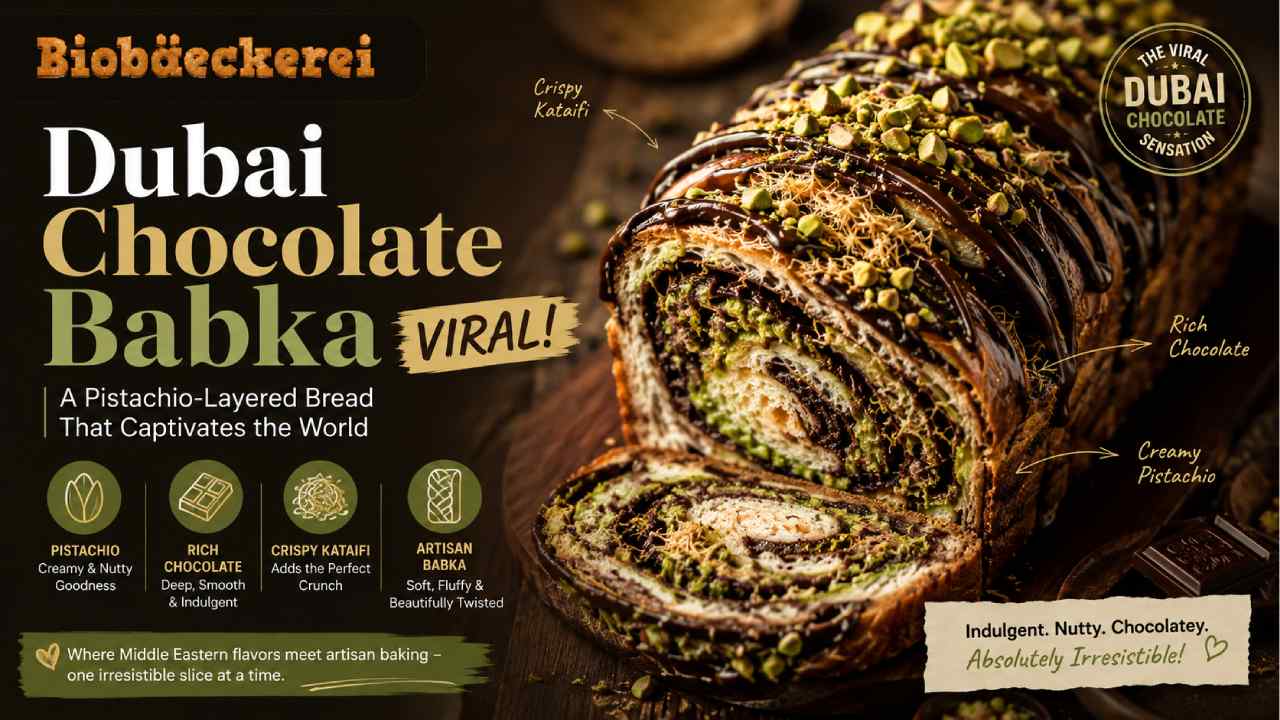
Dubai Chocolate Babka Goes Viral, a Tempting Pistachio-Layered Bread
Biobaeckerei – Dubai Chocolate Babka brings two distinctive pastry ideas into one dramatic loaf. It combines the twisted, layered structure associated with babka and the pistachio-chocolate profile popularized by Dubai chocolate. The result is rich, nutty, chocolatey, and visually striking when sliced. Dubai chocolate itself became an international phenomenon after the pistachio-kataifi chocolate bar from FIX Dessert Chocolatier gained enormous attention on social media. Its defining combination includes chocolate, pistachio cream, and crisp toasted kataifi, often accompanied by tahini. Since then, that flavor profile has moved beyond chocolate bars. Bakers have adapted it into croissants, brownies, cakes, doughnuts, and other desserts. Babka is a particularly natural canvas for the idea. Its rolled dough creates visible layers that can hold pistachio filling, chocolate, and crunchy pastry. Therefore, each slice offers several textures instead of simply tasting like another chocolate bread.
Read Also: KFC x Oreo Launches Unique Black Bun Chicken Burger in China
Dubai Chocolate Started as a Filled Chocolate Sensation
To understand Dubai Chocolate Babka, it helps to understand the dessert trend behind it. The modern Dubai chocolate phenomenon is closely associated with FIX Dessert Chocolatier in Dubai. The company was founded by Sarah Hamouda in 2021. Its famous “Can’t Get Knafeh of It” bar combines a substantial chocolate shell with pistachio cream and toasted kataifi pastry. Kataifi consists of very fine strands of pastry dough. When toasted, it provides the distinctive crunch that contrasts with the smooth pistachio filling. The concept draws inspiration from knafeh, a long-established Middle Eastern dessert tradition. However, the viral chocolate bar is a modern confection rather than traditional knafeh itself. Social media eventually transformed this combination into an international trend. Close-up videos were especially effective because viewers could see the chocolate crack and the green filling appear. As a result, pistachio, chocolate, and crispy kataifi became instantly recognizable as a Dubai-style dessert combination.
Why Babka Works So Well With the Dubai Chocolate Concept
Babka already has the structure needed for an indulgent filling. Bakers typically roll enriched yeast dough into a rectangle, spread it with filling, then roll it into a log. The log can then be split and twisted before baking. Consequently, the finished loaf develops ribbons of filling throughout its interior. Dubai-style flavors fit naturally into that format. Pistachio cream can replace or complement a conventional chocolate filling. Meanwhile, chocolate provides depth and familiar sweetness. Toasted kataifi introduces a third element: crunch. That texture is particularly important because the appeal of Dubai chocolate is not based on pistachio flavor alone. The original concept creates contrast between a firm chocolate shell, creamy filling, and crisp pastry. A babka cannot reproduce that experience exactly. However, it can reinterpret the same principle. Soft bread replaces the chocolate shell as the structural element. Pistachio remains creamy, while toasted kataifi provides crunch. In my view, that contrast is what makes the adaptation more interesting than simply adding pistachio spread to ordinary bread.
Pistachio Creates the Signature Flavor and Color
Pistachio is the ingredient that immediately gives Dubai-style desserts their recognizable character. Its naturally nutty flavor works particularly well with both milk and dark chocolate. Moreover, quality pistachio paste can provide the green tone associated with the viral filling without depending entirely on artificial coloring. FIX describes pistachio cream as a central component of its original chocolate bar. For babka, however, the filling needs careful balance. Too much liquid can make the dough difficult to roll. An extremely sweet pistachio spread can also overpower the bread and chocolate. Therefore, a thick pistachio cream or paste is generally easier to control. Tahini can be added in a modest amount to provide toasted sesame depth. That addition also reflects the flavor profile commonly associated with Dubai chocolate. However, home bakers can adjust the sweetness according to the pistachio product they use. The goal is not simply to make the filling greener or sweeter. Instead, the pistachio should remain clearly recognizable after baking.
Toasted Kataifi Provides the Crunch That Makes It Different
Kataifi may be the most important textural ingredient in this style of babka. These fine strands of dough are commonly used in Middle Eastern and Mediterranean pastry traditions. In Dubai-style chocolate, kataifi is toasted before being combined with pistachio cream. That preparation gives the filling its characteristic crispness. The same principle works for babka. Raw kataifi would not deliver the same toasted flavor or texture. Therefore, it should first be separated into manageable strands and cooked until golden. Butter can help it brown evenly. Once cooled, some of the pastry can be folded into the pistachio mixture. Another portion may be reserved for the top. However, moisture naturally softens crisp pastry over time. A freshly baked loaf will usually offer a stronger contrast than one stored for several days. For that reason, adding a small amount of freshly toasted kataifi shortly before serving can restore some crunch. This simple detail makes the final bread feel closer to the Dubai chocolate experience.
Chocolate Balances the Richness of the Pistachio Filling
Chocolate does more than make the babka look decadent. It creates bitterness, sweetness, and cocoa depth that balance the richness of pistachio. Dark chocolate can produce a stronger contrast, especially when the pistachio filling is already sweet. Milk chocolate creates a softer and sweeter profile. Meanwhile, combining both can offer a middle ground. The original Dubai chocolate concept commonly uses a chocolate shell around its pistachio-kataifi center. In babka, chocolate can appear in several forms. Melted chocolate may be spread across the dough. Chopped chocolate can create pockets throughout the loaf. Cocoa can also be incorporated into a thicker filling. However, moderation matters. Too much filling may escape when the dough is rolled and twisted. Therefore, leaving a small border around the dough makes shaping easier. A well-balanced loaf should allow chocolate and pistachio to remain distinct. Neither ingredient needs to dominate every bite. Instead, their contrast gives the babka a more complex flavor.
A Practical Dubai Chocolate Babka Formula for Home Bakers
A home version can begin with an enriched yeast dough made from flour, milk, yeast, eggs, sugar, butter, and salt. For one large loaf, roughly 350–400 grams of flour provides a practical starting point. After kneading, the dough should rise until noticeably expanded. Meanwhile, prepare the filling using approximately 150 grams of thick pistachio cream, 70–100 grams of chocolate, and 70–100 grams of kataifi. Toast the kataifi in a little butter until golden, then let it cool. Next, roll the dough into a rectangle. Spread the pistachio mixture thinly and evenly. Add chocolate and some toasted kataifi. Then, roll the dough tightly from the longer side. Chill the log briefly if it feels too soft. After that, split it lengthwise and twist the two sections together with the cut sides facing upward. Transfer it to a loaf pan, allow a second rise, and bake until deeply golden and cooked through.
Baking Temperature Matters More Than Appearance Alone
A beautifully browned babka can still be underbaked in the center. This happens because enriched dough contains butter, eggs, and sugar. A heavy filling also slows heat penetration. Therefore, home bakers should not judge doneness by surface color alone. A moderate oven, around 175–180°C or 350°F, is a sensible range for many babka recipes. Exact baking time depends on loaf size, pan material, and oven performance. If the top darkens too quickly, loosely covering it with foil can help. Meanwhile, the center should feel set rather than wet or doughy. An instant-read thermometer provides additional guidance for enriched bread, although recipe-specific instructions should remain the primary reference. After baking, allow the loaf to cool before cutting it. This waiting period matters because the filling remains extremely hot and soft immediately after leaving the oven. Moreover, cutting too early can compress the delicate interior. Patience, therefore, improves both texture and presentation.
The Viral Appeal Comes From Texture as Much as Flavor
Food trends often succeed online because they create a strong visual moment. Dubai chocolate is an excellent example. Its viral videos emphasize the snap of the chocolate shell, vivid pistachio filling, and audible crunch of kataifi. FIX attributes much of the product’s global recognition to this highly visual social-media experience. Dubai Chocolate Babka translates that same appeal into bakery form. Instead of breaking a chocolate bar, viewers see a twisted loaf being sliced open. The cross-section reveals alternating lines of bread, pistachio, chocolate, and pastry. Moreover, tearing a warm piece apart creates another visually satisfying moment. Yet appearance alone does not guarantee a good dessert. A successful babka still requires proper fermentation, careful shaping, and controlled filling. Otherwise, the loaf may look impressive while remaining dense or excessively sweet. In other words, virality can attract the first bite. Good baking determines whether someone wants a second slice.
Dubai Chocolate Has Expanded Far Beyond the Original Bar
The broader food trend helps explain why a babka interpretation makes sense. Once Dubai chocolate became globally recognizable, pastry chefs began applying the pistachio-kataifi-chocolate combination to other formats. Food & Wine documented adaptations including croissants, brownies, cakes, doughnuts, and other desserts. By 2026, the flavor profile had also appeared across beverages, shakes, and bakery products. This evolution is common in modern food culture. A successful product becomes a flavor concept, then that concept travels across categories. However, there is an important distinction. A pistachio-kataifi babka should be described as Dubai chocolate-inspired, unless it actually comes from the creator of the original chocolate. That wording respects the origin of the trend while allowing bakers to experiment. It also prevents consumers from assuming that every green pistachio dessert labeled “Dubai” represents the original product. For publishers and food businesses, that distinction improves both accuracy and transparency.
Serving the Babka While Fresh Gives the Best Experience
Dubai Chocolate Babka is particularly appealing when the crumb remains soft and the filling still feels fresh. Once cooled enough to slice, it can be served with coffee, tea, or unsweetened milk. The loaf is already rich, so elaborate side dishes are unnecessary. For presentation, a thin chocolate drizzle can reinforce the cocoa flavor. Chopped pistachios also add color and texture. Meanwhile, freshly toasted kataifi scattered over the top can restore crunch. Avoid covering the entire loaf with an extremely thick layer of pistachio cream. Although visually dramatic, excessive topping may make the dessert overwhelmingly sweet and heavy. Instead, allow the twisted structure to remain visible. Leftovers should be stored carefully because enriched bread gradually dries when exposed to air. If the filling contains ingredients that require refrigeration, follow the storage guidance for those specific products. Before serving leftovers, gentle reheating can soften the crumb again. However, any crunchy kataifi topping is best added afterward.
Dubai Chocolate Babka Shows How Viral Food Trends Evolve
The most interesting part of Dubai Chocolate Babka is not simply its luxurious appearance. It demonstrates how modern food trends travel between cultures and formats. Dubai chocolate took inspiration from Middle Eastern dessert flavors and combined them with a filled chocolate-bar format. Now, bakers are taking its pistachio, chocolate, tahini, and kataifi profile into entirely different pastries. Babka provides an especially effective canvas because its twisted layers naturally showcase fillings. However, the strongest versions should still respect the identity of each component. Pistachio needs to taste nutty rather than merely sweet. Kataifi should contribute noticeable crunch. Chocolate should add depth without overpowering everything else. Finally, the bread itself should remain soft and properly fermented. When those elements work together, the dessert becomes more than an internet novelty. It turns a viral flavor combination into a genuinely compelling bakery creation, while still acknowledging that the original Dubai chocolate phenomenon began with a very different product.
